
Why Your Room Feels Off: 6 Things to Check Before You Buy Anything
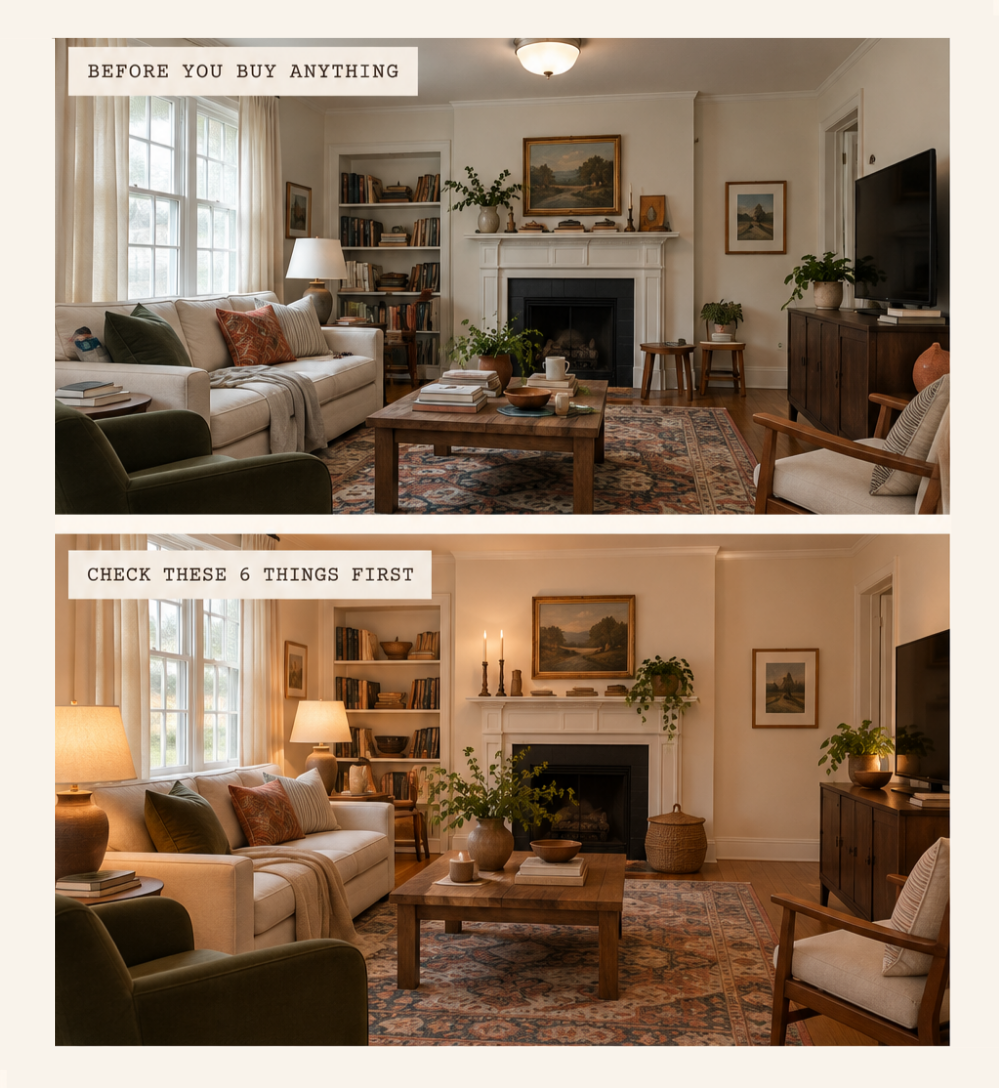
You know the feeling…
The room is clean. The furniture is decent. You’ve added art, pillows, maybe a plant that is bravely hanging on despite your forgetfulness.
And still… something is off. Not dramatically off. There’s no visible design crime scene. The room just feels flat, awkward, unfinished, or vaguely like a rental staged by someone who has never actually sat down.
Before you buy a new sofa, replace every piece of furniture, or start panic-ordering baskets, check these six things first.
Your room may not need a makeover. It may just need a reset.
1. Function: Is the room actually working for your life?
A beautiful room that is annoying to use is not a successful room. It is just a very attractive inconvenience. Ask:
Can people move through the room easily?
Is there somewhere to set down a drink?
Are the things you use most within reach?
Does the furniture support the way you actually spend time here?
Is the room trying to do too many jobs at once?
Sometimes a room feels “wrong” because it is asking the furniture to do something it was never arranged to do. A living room might look lovely but have nowhere comfortable to read. A dining room might technically seat six but make serving dinner feel like an Olympic event. A family room might have beautiful storage that requires moving three decorative objects and a small emotional support ladder every time someone needs a board game.
Try this first: Spend one normal day noticing where the room annoys you. Where it makes real life harder… Then, move the lamp closer. Put the basket where the blankets actually land. Add a side table where someone keeps balancing a coffee mug on the arm of the sofa. Fix the behavior before buying a solution.
2. Flow: Can people move through the room without entering an obstacle course?
A room can feel off simply because the pathways are awkward. You should be able to move through the space naturally without squeezing between furniture, walking around the back of a sofa or performing a little sideways shuffle every time you cross the room. Pay attention to the routes you take every day. Where do you naturally walk? Where do people drop bags? Which chair gets bumped? Is a drawer blocked? Does the rug make the room feel visually disconnected because it is floating in the middle like a lonely island?
Try this: Clear the main walking path as much as possible. Move one piece of furniture a few inches—or rotate it entirely—and see whether the room immediately feels calmer. You do not need a larger room. You may just need fewer things interrupting its flow.
3. Light: Are you illuminating the room or interrogating it?
One overhead light in the middle of the ceiling is rarely enough to make a room feel warm. It may be technically bright, but “technically bright” is not the same as inviting. A single ceiling fixture often creates a room that feels flat, harsh, and strangely similar to a dentist’s waiting room. Check whether your room has a mix of:
Overhead lighting
Task lighting
Ambient lighting
Light at different heights
Warm bulbs rather than glaring blue-white ones
Light near the places where people actually sit and gather
The goal is not merely to see everything. The goal is to create atmosphere and give the room visual depth.
Try this first - Turn off the overhead light at night and experiment with the lamps you already own. Move one lamp lower. Put another in a darker corner. Try lighting the room from the sides instead of blasting it from above. If the room immediately feels better, congratulations: you may not need new furniture. You may need fewer ceiling-light crimes.
4. Focus: Does the room have somewhere for your eye to land?
A room can feel chaotic even when it is not cluttered. It can also feel boring even when it contains plenty of stuff. The difference is often focus. Every room needs some kind of visual anchor: a fireplace, a great piece of art, a dramatic light fixture, a view, a beautiful table, an interesting wall, or even a particularly excellent pile of books. Without a focal point, the eye bounces around looking for something to settle on. The room feels unfinished because nothing is confidently in charge.
Try this: Stand at the entrance to the room and notice what you see first. If the answer is “everything,” edit the view. Remove a few small objects, group similar things together or create one stronger arrangement. A room often feels more intentional when you give the eye a beginning point.
5. Scale: Are the pieces the right size for one another?
Scale problems are sneaky. Nothing is necessarily ugly, but the relationships are wrong. A tiny rug under a large seating arrangement can make the furniture feel disconnected. Small artwork above a substantial sofa can look timid. A petite lamp beside an oversized bed may appear to be losing an argument. Before buying anything, look at the room as a collection of relationships:
Is the rug large enough for the furniture?
Are the curtains mounted high and wide enough?
Does the coffee table relate to the size of the sofa?
Are your accessories all the same small scale?
Is there enough visual weight in the room?
Try this: Temporarily remove a few small accessories and bring larger existing pieces closer together. Sometimes the room feels better with fewer, more substantial elements—not more stuff.
6. Personality: Does the room look like you live there, or like you selected “neutral home” from a dropdown menu?
A room can be tidy, attractive and completely devoid of evidence that an actual person lives there. If everything comes from the same collection, the same store or the same beige mood board, the room may feel coordinated but not collected. Personality comes from contrast and specificity: a strange little object, an inherited chair, art from a place you love, an unexpected color, a vintage find or something that makes you laugh.
Try this: Add one thing that is not perfectly coordinated but feels unmistakably like you. Then remove one item that is only there because you thought the room was supposed to have it. Interesting homes are not created by matching everything. They are created by making room for a few unexpected things.
The No-Buy Room Reset
Before purchasing anything, try this order:
Function: Fix what is annoying to use.
Flow: Move furniture and clear pathways.
Light: Adjust the lighting you already have.
Focus: Give the eye somewhere to land.
Scale: Group, enlarge, or reposition small elements.
Personality: Add one unexpected, personal detail.
Then live with the room for a few days. Only after that should you decide what is genuinely missing. Maybe it needs a larger rug. Maybe it needs a lamp. Maybe the empty corner really does require a chair. But now you’ll be shopping with a diagnosis instead of wandering around the internet hoping a $38 decorative object will save you. That is how rooms get expensive.
The takeaway
When a room feels off, the answer is not always more stuff. Sometimes the furniture needs to move. Sometimes the lighting is being rude. Sometimes the room has no focal point. Sometimes it is perfectly styled and completely devoid of a pulse. Start with the room you have. Make it function better. Make it feel warmer. Give it a little tension and a little personality. Then shop only for what the room actually needs.
If you want a step-by-step system for doing exactly that, The Room Reset walks you through the process of identifying what is not working, using what you already own, making the highest-impact changes first, and shopping intentionally afterward.
